Blog · 5 July 2025 · Niraj Sharma
AI vs Rule-Based ANPR: What Works Better for Indian Number Plates
Indian license plates break assumptions baked into off-the-shelf OCR: state codes, multi-line commercial formats, legacy styles, and monsoon glare on angled cameras. Pure rule engines excel at speed and interpretability but crumble when fonts and weather vary; deep learning improves recall when trained on local data but demands MLOps discipline. We compare accuracy, latency, cost, and hybrid architectures used in production Parkadda lanes across Multiplexer Solution deployments.
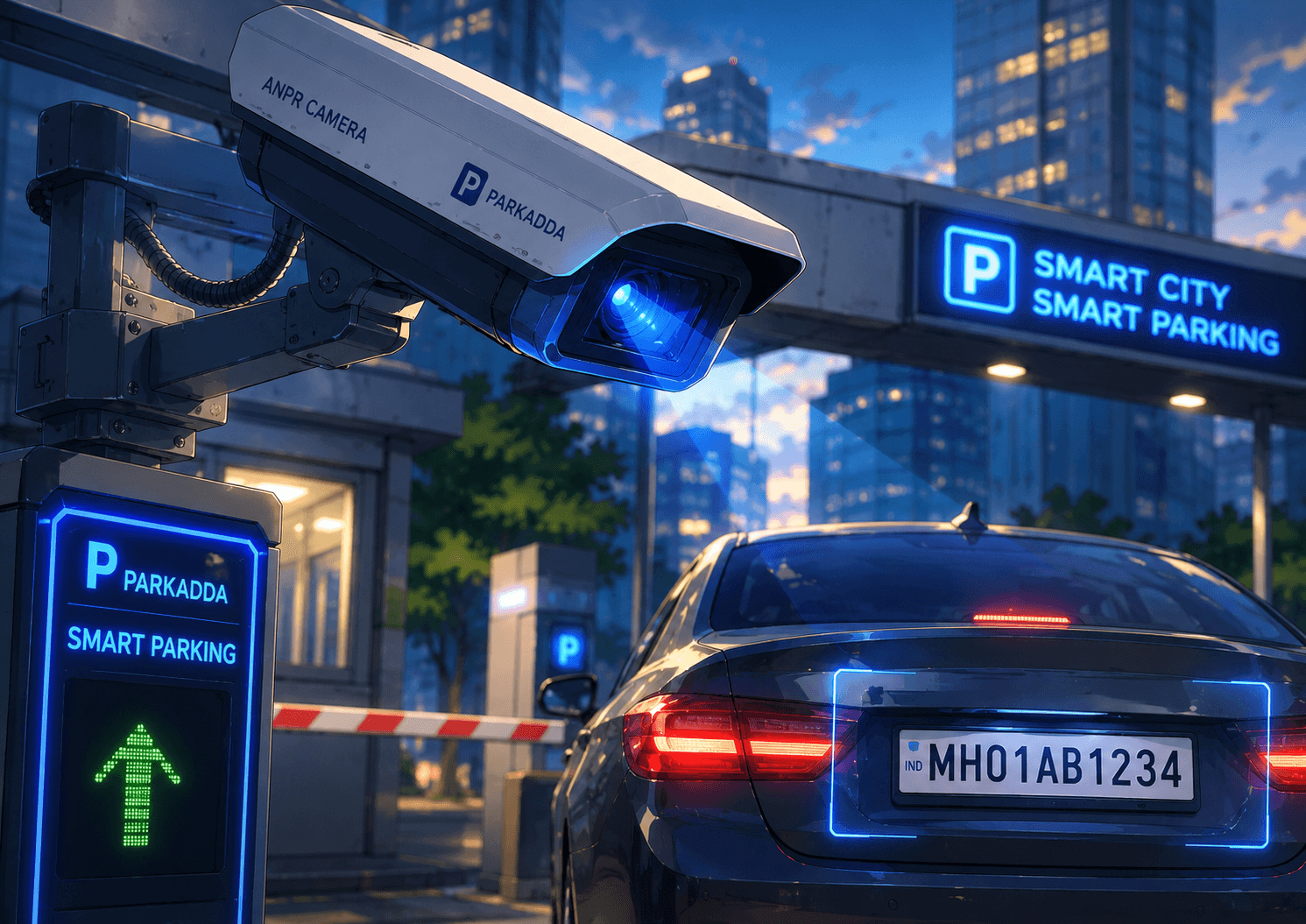
License plate recognition sounds like a solved problem until you deploy on a congested Indian lane during monsoon evening rush. Plates are partially occluded by bull bars; reflective films glare; auto-rickshaws expose smaller plate areas; and state series change faster than vendor regex libraries update. Engineering teams then face a fork: invest in classical rule-based OCR pipelines or adopt modern vision models marketed as AI ANPR.
Multiplexer Solution operates both approaches in R&D and production Parkadda lanes. This article compares rule-based and AI-driven recognition for Indian plates—accuracy, latency, operability, and cost—without vendor hype.
How Rule-Based ANPR Works
Classical pipelines chain computer-vision stages: vehicle detection, plate localization (often color or edge heuristics), perspective correction, character segmentation, and template or OCR engine recognition constrained by regular expressions. Indian state codes and series patterns encode into rules: position of letters, allowed alphabets, checksum digits where applicable.
Strengths
- Predictable latency: Bounded processing on modest CPUs when rules fit
- Interpretability: Failures trace to specific regex or segmentation steps
- Low GPU dependence: Attractive for edge boxes with tight power budgets
- Deterministic tuning: Engineers adjust rules without retraining datasets
Weaknesses on Indian Roads
Rules assume stable plate geometry and font. Commercial vehicles violate segmentation. Faded paint breaks character classifiers. Night glare splits digits across thresholds. Angled lanes in narrow mall basements distort aspect ratios. Maintenance becomes whack-a-mole: every new plate variant needs a rule patch.
How AI-Based ANPR Works
Modern systems use convolutional or transformer-based detectors to find plates, then sequence models (CRNN, attention decoders) or specialized OCR networks to read characters end-to-end. Training on thousands of labeled Indian images teaches invariances to rain, mud, and skew—within limits.
Strengths
- Higher recall on diverse plates: When training data covers state variants and commercial formats
- Robustness to moderate skew and blur: Learned features outperform hand-tuned thresholds
- Faster iteration on new series: Retrain or fine-tune instead of rewriting regex forests
Weaknesses
- Data hunger: Without Indian labels, models replicate textbook demos, not Srinagar lanes
- GPU or NPU preference: Edge hardware cost rises
- Opacity: Misreads harder to diagnose without tooling
- Drift: New plate designs require MLOps pipelines, not one-time launch
Benchmark Dimensions That Matter
Buyers should demand metrics collected on their lanes, not brochure numbers from other countries.
Accuracy Metrics
- Detection rate: Frames where a plate box is found when a vehicle is present
- Character error rate: Edits needed to match ground truth
- Session-level recall: Entries and exits closed without manual correction—what operators feel
AI models often win on character error rate when trained on representative Indian data. Rules can match on pristine indoor lanes with fixed camera angles. Mixed outdoor municipal lanes favor learned models.
Latency and Throughput
Barrier decisions need sub-second inference at exit peaks. Optimized edge GPUs run compact models within budget; heavy cloud round trips fail regardless of model quality. Parkadda benchmarks pipelines on the same hardware deployed in Smart Srinagar and mall sites—Jetson-class devices, industrial PCs, and selected ARM boxes.
Hybrid Architectures in Production
The best deployed systems are rarely pure. Parkadda uses hybrid flows:
- AI detector localizes plate; rule validator checks state code and format plausibility
- High-confidence AI read passes; low-confidence routes to secondary OCR or operator UI
- Whitelist and fuzzy match correct single-character errors for monthly pass holders
- Temporal fusion across frames reduces one-off misreads on video streams
Rules act as guardrails preventing billing on nonsense strings. AI handles messy imagery rules cannot segment.
Operational Considerations
Model Updates and Governance
AI deployments need versioned models, rollback, and A/B testing on shadow lanes. Municipal contracts should specify who approves model upgrades and how accuracy is re-certified. Rule-based systems need regex change logs with equal discipline.
Explainability for Disputes
When a citizen disputes a charge, operators must show evidence: crop image, confidence score, timestamp. Parkadda stores redacted plate crops per privacy policy. AI systems should expose confidence thresholds that triggered auto billing vs manual review.
Cost Over Five Years
Rule-based stacks look cheaper upfront—lower hardware, no labeling budget. Hidden costs accumulate: engineer time per new plate variant, queue delays from manual corrections, revenue loss from exit mis-association. AI adds GPU capex and labeling opex but reduces manual labor and leakage when recall improves.
Multiplexer Solution advises corporations to model total cost of ownership including booth staffing, not license fees alone.
When to Choose What
- Rule-heavy: Controlled indoor lanes, uniform plates, low traffic, tight CPU budget
- AI-first: Outdoor municipal, mixed commercial traffic, high throughput, weather exposure
- Hybrid (recommended): Indian municipal and commercial deployments at scale
Parkadda’s Approach
Parkadda trains on Indian data collected across Multiplexer deployments—with consent and security appropriate to municipal contracts. Models compress for edge inference; validators enforce plate grammar; operator UX catches tail failures. The goal is session-level accuracy that finance trusts, not leaderboard scores on foreign datasets.
Indian number plates will keep evolving. The question is not AI or rules—it is whether your parking platform can evolve with them. Parkadda is built for that operational reality.