Blog · 1 November 2025 · Niraj Sharma
How ANPR Is Transforming Smart Parking in Indian Cities
Automatic number plate recognition is replacing manual gate logs across municipal and commercial parking deployments from Srinagar to Bengaluru. Indian operators need systems that handle regional plate formats, mixed vehicle types, and peak-hour congestion without slowing traffic. Parkadda by Multiplexer Solution delivers production-grade ANPR lanes that integrate barriers, payments, and centralized dashboards for city-scale rollouts.
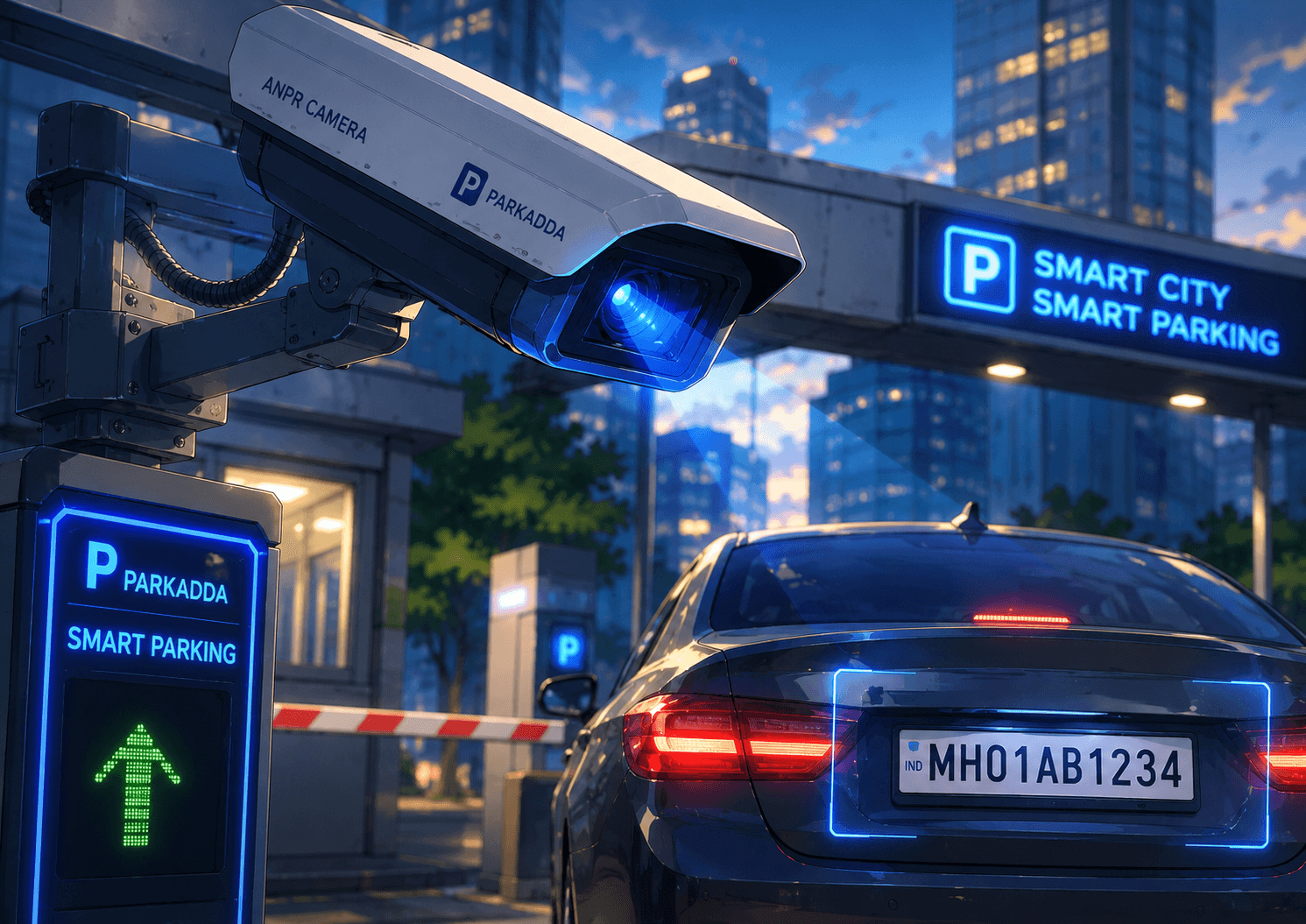
Indian cities are growing faster than their parking infrastructure can keep pace. Curbside zones overflow during festivals, mall basements queue for twenty minutes on weekends, and municipal corporations still rely on paper tokens at hundreds of entry points. Automatic Number Plate Recognition (ANPR) is changing that equation by giving operators a digital identity for every vehicle the moment it crosses a camera line—no clipboard, no manual number entry, and no dispute about dwell time at exit.
What makes ANPR transformative in India is not the technology alone but how it fits local constraints: state-specific plate fonts, commercial vehicles with multi-line plates, two-wheelers sharing lanes with SUVs, and the expectation that FASTag, UPI, and cashless options coexist at the same gate. Multiplexer Solution built Parkadda around these realities, deploying ANPR-first lanes from Smart Srinagar municipal zones to corporate campuses and hospital parking across the country.
Why Manual Gate Logs Fail at Scale
Traditional parking operations depend on attendants recording vehicle numbers, issuing paper slips, and reconciling revenue at shift end. This model breaks under volume. Peak-hour queues grow because handwriting and lookup are slow. Revenue leakage appears when tokens are reused or exits are not matched to entries. Enforcement teams lack audit trails when disputes arise about overstay or wrong-slot parking.
Municipal corporations face additional pressure: elected bodies demand transparent revenue reporting, citizens expect digital payment options, and traffic police want integration with violation workflows. A camera-based entry log creates an immutable timestamped record tied to a plate string, which becomes the backbone for billing, occupancy analytics, and integration with city command centers.
Operational Gains Operators See in the First 90 Days
- Faster throughput: Recognized plates trigger barrier rules automatically; attendants focus on exceptions only.
- Accurate dwell billing: Entry and exit events pair to compute minutes parked without manual calculation.
- Audit-ready records: Every session is searchable by plate, lane, and timestamp for finance and enforcement.
- Centralized visibility: Multi-site operators view live occupancy and revenue from one Parkadda dashboard.
- Payment alignment: ANPR sessions map cleanly to UPI, FASTag, and prepaid account workflows.
Indian Plate Diversity and Why Generic ANPR Struggles
Global ANPR vendors often train on European or North American plate standards. India presents a different computer-vision problem. States issue plates with distinct color schemes, font sizes, and series formats. Commercial vehicles may carry additional text above or below the registration line. Older vehicles still run legacy plate styles alongside the current standardized design.
Environmental factors compound the challenge. Monsoon rain streaks across lenses; summer dust coats camera housings; headlights at night create bloom on entry lanes. Angled mounts on narrow lanes produce perspective distortion. A system that works in a lab demo fails on day three unless it is tuned for Indian roads and retrained on local data.
Parkadda addresses this with models and pipelines trained on Indian plate variants, edge preprocessing for glare and rain, and lane-level calibration workflows that field engineers use during commissioning. The goal is not perfect recognition on every frame—it is high enough recall to keep traffic moving while routing low-confidence reads to a quick operator override without blocking the queue.
Architecture of a Production ANPR Lane
A typical Parkadda ANPR lane combines industrial cameras, controlled lighting, edge compute, and cloud sync. Cameras capture entry and exit with overlapping fields of view so a plate is visible even when a driver stops short of the loop detector. Infrared illuminators improve night performance without dazzling drivers.
Edge Processing vs Cloud-Only Recognition
Latency matters at a busy gate. Waiting for a round trip to a distant cloud region adds seconds per vehicle; multiplied by hundreds of vehicles per hour, the lane backs up. Parkadda runs recognition close to the lane—on edge appliances or local servers—so barrier decisions happen in milliseconds. Cloud services receive session events for dashboards, mobile apps, and long-term analytics, but the gate does not depend on continuous internet availability for basic entry-exit logic.
When connectivity returns after an outage, buffered events sync upstream so revenue and occupancy reports stay consistent. Operators configure fallback rules: allow entry on whitelist, block unknown plates, or route to manual payment booths depending on site policy.
Integration with Barriers, Payments, and Command Centers
ANPR is most valuable when it drives downstream systems. Parkadda connects plate reads to boom barrier controllers, FASTag readers, QR payment flows, and operator tablets. A monthly-pass holder’s plate can raise the barrier without stopping; a visitor receives a UPI QR linked to the ANPR session ID; a municipal enforcement officer can query whether a vehicle overstayed in a no-parking zone.
For government deployments such as Smart Srinagar, centralized monitoring is essential. Command-center screens show lane health, camera status, live entries, and revenue by zone. Incidents—camera offline, barrier fault, unusual queue length—surface as alerts so staff respond before citizens post complaints on social media.
Security and Privacy Considerations
Plate data is sensitive. Municipal contracts require retention policies, role-based access to search tools, and secure transport between edge and cloud. Parkadda implements access controls so booth operators see only what they need for their shift, while auditors and administrators have broader reporting with logged queries. Encryption in transit and at rest is baseline; deployment hardening includes VPN or private links for government networks where public internet exposure is not acceptable.
Deployment Patterns Across India
ANPR lanes are not one-size-fits-all. Off-street municipal lots use entry-exit pairing with time-based tariffs. On-street zones may use mobile enforcement with ANPR on patrol vehicles. Corporate campuses combine ANPR with employee whitelists and visitor pre-registration. Hospitals prioritize ambulance lanes and short-stay drop-off zones with separate rules.
Multiplexer Solution’s field teams follow a repeatable commissioning playbook: site survey, lane design, camera height and angle, lighting test at night, model calibration on local plates, barrier interlock verification, payment sandbox, operator training, and hypercare for the first month. This discipline is why deployments from Kashmir to the Deccan plateau reach stable recognition rates rather than stalling in pilot purgatory.
Measuring Success: KPIs That Matter
Technology buyers should track metrics tied to business outcomes, not vendor slide decks alone.
- Recognition recall at exit: Percentage of sessions closed automatically without manual plate entry.
- Median lane processing time: Seconds from stop to barrier open for recognized vehicles.
- Revenue reconciliation variance: Difference between ANPR-session revenue and cash counts.
- Queue length during peaks: Visual or sensor-based backup beyond a defined threshold.
- Hardware uptime: Camera and barrier availability per lane per month.
Parkadda dashboards expose these indicators so operators tune tariffs, staffing, and maintenance before small issues become public failures.
The Road Ahead for Smart Parking in India
Union and state policies increasingly favor digitized urban mobility. Smart city missions fund parking modernization; FASTag penetration creates expectations for touchless payment; citizens want apps that show availability before they leave home. ANPR is the identity layer that connects vehicles to payments, occupancy, and enforcement in one coherent system.
Multiplexer Solution continues to invest in Indian plate datasets, edge hardware partnerships, and tighter integration with municipal ERP and payment gateways. Whether you operate a single commercial basement or a city-wide parking network, ANPR is no longer a luxury experiment—it is the operational baseline for credible smart parking in India. Parkadda is built to deploy that baseline with the uptime, local accuracy, and government-grade support that Indian operators require.