Blog · 10 August 2025 · Vikas Singh
Smart Srinagar: India's First Municipal Smart Parking Deployment
Smart Srinagar stands as a landmark municipal smart parking program—ANPR lanes, digital payments, boom barriers, and a centralized command center replacing paper tokens across city zones. Multiplexer Solution delivered end-to-end hardware, Parkadda software, operator training, and sustained field support in challenging terrain and climate. This case study documents architecture choices, rollout phases, and lessons for other Indian cities planning similar modernizations.
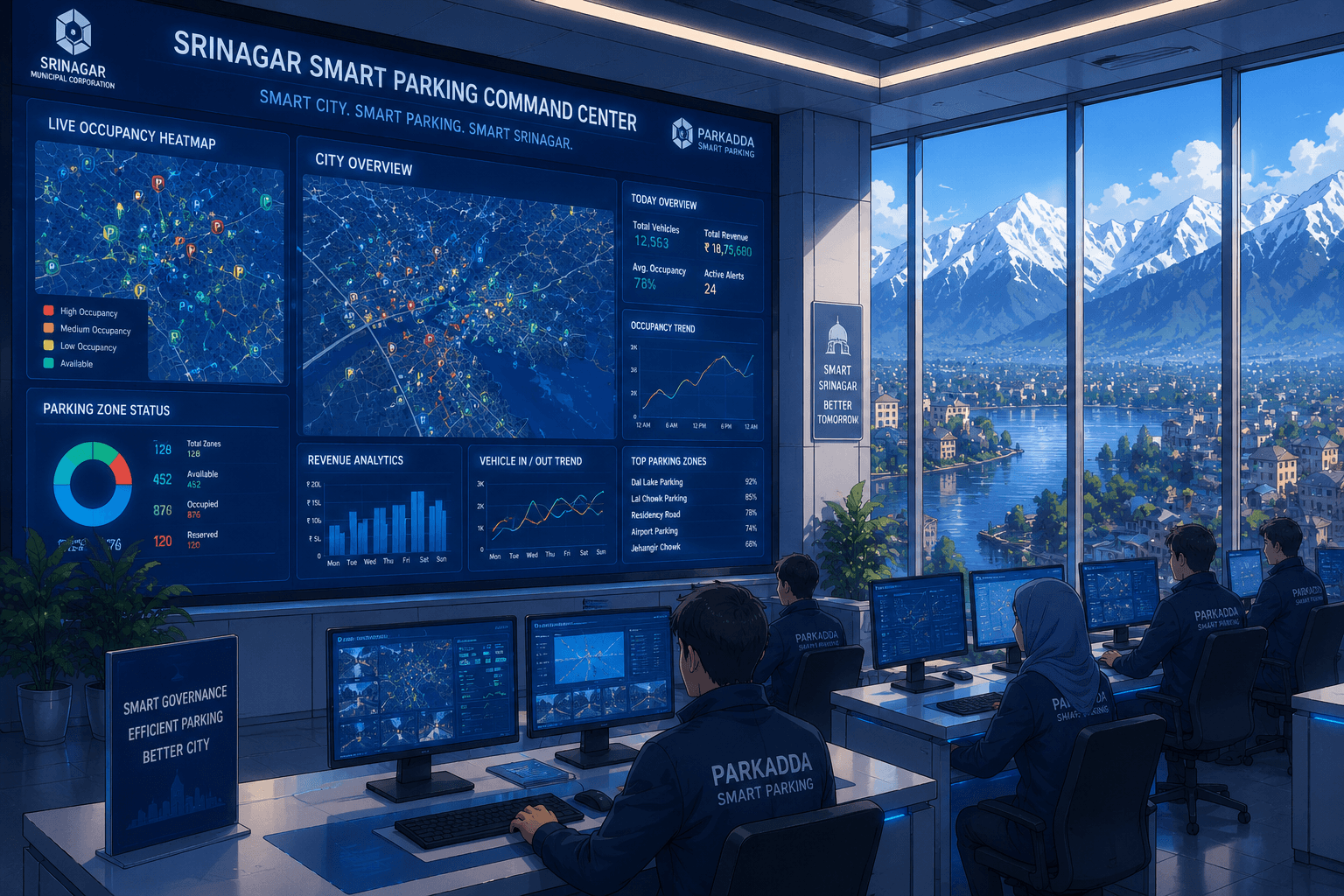
When Srinagar Municipal Corporation set out to modernize urban parking, the goals were familiar to every Indian city leader: reduce congestion around commercial cores, improve revenue transparency, give citizens cashless options, and replace fragile manual processes with auditable digital records. Smart Srinagar became a reference deployment—India’s first municipal smart parking program at this scale combining ANPR, automated barriers, centralized monitoring, and the Parkadda platform from Multiplexer Solution.
This article is a field-level look at what was built, how phases rolled out, and what other municipal corporations can learn when planning RFPs, budgets, and change management for smart parking.
Context: Parking Pressure in a Growing Capital
Srinagar’s commercial districts, healthcare corridors, and tourist-adjacent zones experience sharp demand spikes. Seasonal tourism, local markets, and government office traffic converge on limited curbside and off-street capacity. Before modernization, attendants issued paper slips, cash dominated settlements, and leadership lacked real-time visibility into zone utilization or daily collections.
The Smart City mission provided policy tailwinds and funding discipline. The corporation needed a partner who could deliver Indian-plate ANPR, integrate payments locals actually use, train municipal staff, and maintain systems through Kashmir’s weather—from winter cold affecting electronics to summer dust on outdoor lanes.
Program Scope and Objectives
The deployment was structured around measurable outcomes rather than hardware counts alone:
- Digitize entry and exit with ANPR-backed session records
- Enable cashless payment including UPI and compatible card flows
- Centralize monitoring for lane health, queues, and revenue
- Provide enforcement-friendly audit trails for overstays and violations
- Improve citizen experience with clearer tariffs and faster exits
Parkadda served as the software backbone: lane orchestration, operator portals, command-center dashboards, and reporting aligned to municipal finance cycles.
Technical Architecture
Lane Components
Each modernized zone received camera-based ANPR at entry and exit, industrial barriers with safety loops, booth tablets for exceptions, and edge compute to keep gates responsive when uplink latency spikes. Lighting and camera housings were specified for low-light performance critical during early morning and evening peaks.
Command Center
A centralized view aggregates live entries, occupancy estimates where sensors exist, lane offline alerts, and revenue by zone. Supervisors intervene when queues build—reassigning staff or opening manual overflow per playbook—rather than learning hours later from complaints.
Connectivity and Resilience
Municipal networks vary site to site. Edge buffering ensures sessions complete locally and sync when links recover. Maintenance SLAs define maximum downtime per lane; spare camera and barrier controllers reduce mean time to repair.
Phased Rollout Strategy
City-wide big-bang cutovers risk public backlash. Smart Srinagar phased by priority zones: high-revenue commercial pockets first, then hospital and office corridors, then expansion to additional lots as operators gained confidence.
Phase Activities
- Survey and design: Lane geometry, traffic flow, pedestrian safety, power sources
- Civil and electrical: Foundations, conduit, network drops, signage
- Install and calibrate: ANPR tuning on local plates; barrier interlocks
- Parallel run: Shadow mode comparing digital sessions to legacy counts
- Go-live and hypercare: On-site engineers during first weeks; daily standups with corporation IT
- Training: Booth staff, supervisors, finance reconcilers, helpdesk scripts in Urdu and English
Change Management and Citizen Communication
Technology succeeds when the public understands new rules. The corporation used signage at lanes, local media, and social channels to explain tariffs, cashless options, and where to dispute charges. Booth staff received scripts for common questions: damaged plates, visitors without UPI, and emergency vehicles.
Transparency built trust. Published tariff boards matched Parkadda configuration so software charges align with posted rates—a recurring pain point in less disciplined deployments.
Revenue and Governance Impact
Digital sessions reduce leakage from manual tokens and unrecorded exits. Finance teams export daily collections with user and zone attribution. Auditors trace adjustments to supervisor accounts. Political leadership receives dashboards without relying on anecdotal booth reports.
Revenue uplift varies by baseline discipline; Smart Srinagar’s primary win often cited internally is visibility—knowing which zones earn, which lanes fail, and when to invest in expansion vs enforcement.
Challenges Unique to the Region
Deployments in Srinagar face logistics and climate considerations mainland RFPs underestimate. Equipment shipping windows, skilled technician availability, and cold-weather effects on barrier hydraulics require planning. Camera heating and sealed enclosures mitigate fog and frost. Dust management on outdoor lanes is part of preventive maintenance, not optional.
Multiplexer Solution maintained local support partnerships so incidents do not wait for flights from distant metros. Spares inventory for cameras, barriers, and edge devices was staged regionally.
Security and Data Handling
Municipal plate data demands strict access control. Parkadda roles separate booth operator, supervisor, auditor, and system administrator privileges. Administrative searches are logged. Network designs follow corporation IT standards—often VPN access to cloud dashboards rather than public exposure of control interfaces.
Lessons for Other Municipal Corporations
- Buy outcomes, not gadgets: Specify recognition rates, uptime, and reconciliation—not just camera counts.
- Plan exceptions: Every lane needs a fast manual path when technology fails.
- Integrate finance early: Chart of accounts mapping before go-live prevents month-end surprises.
- Phase with hypercare: First 30 days define public perception permanently.
- Choose India-tuned ANPR: Generic imports fail on local plates and weather.
Smart Srinagar as a Blueprint
India’s urban parking crisis will not be solved by one city alone—but Smart Srinagar proves municipal smart parking is deployable with Indian technology, realistic phasing, and sustained operations support. Parkadda and Multiplexer Solution continue to evolve features from this program: command-center analytics, multilingual operator UX, and integration paths for state payment gateways.
Corporations drafting smart parking RFPs can reference Smart Srinagar for architecture, staffing models, and KPI definitions. The goal is not novelty; it is accountable, citizen-friendly parking that works on the street, not just in presentation slides.